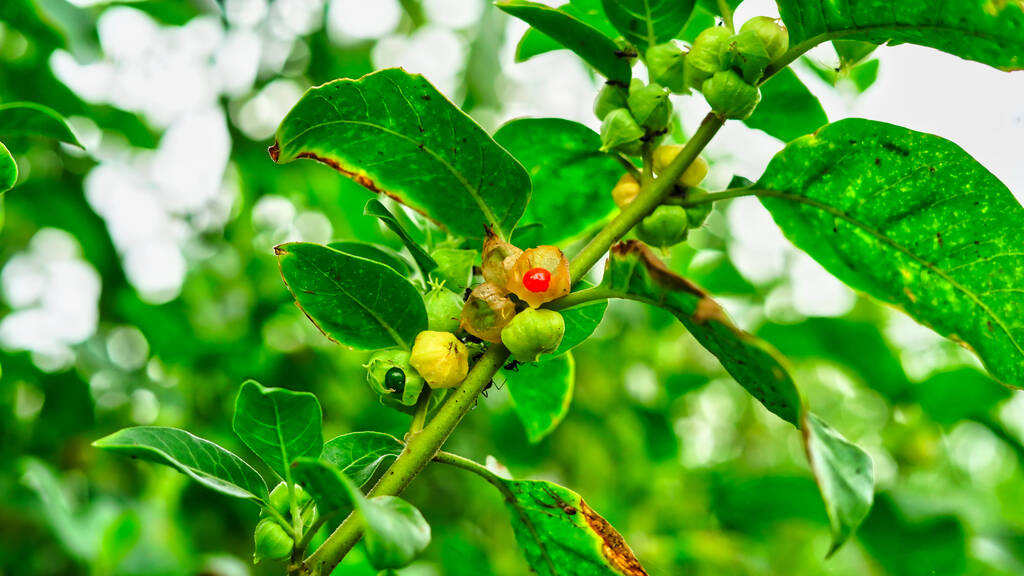
Safety First: Education, not prescription. Plants are powerful; bodies are individual. When in doubt, consult a clinician who likes both humans and evidence.
Ashwagandha
🌱 Overview

A classic rasāyana from Ayurveda, often framed as a steadiness tonic. The name nods to the root’s barnyard aroma and the hoped-for vitality of a horse.

Also known as
Ashwagandha, Indian ginseng, Winter cherry
Parts used
Root (primary), Leaf (traditional, less common), Berry (rare, caution)
Forms
Root powder (traditional churna), Standardized extract (withanolides), Capsule / Tablet, Tincture, Warm milk decoction (traditional)
📖 Background
Who
Ayurvedic physicians and householders across the Indian subcontinent; later, Greco-Arab (Unani) physicians adopted analogues; modern phytotherapists use standardized extracts.
What
A small shrub; roots are the main medicinal part. Classed as a rasāyana (rejuvenator). In modern parlance often labelled “adaptogen.”
When
Referenced for millennia (classical texts dated 1st millennium BCE onwards). Standardized extracts proliferated in the late 20th century.
Where
Native to dry regions of India and the Middle East; cultivated in parts of Africa; now grown more widely for supplements.
Why
Bridges folk practice and modern inquiry: stress resilience, perceived sleep quality, and calm. Interest persists because trials show signals—though results vary by extract, dose, and study rigor.
🧭 Common Uses
  • Traditional: restorative tonic for “weakness,” sleep support, convalescence, and resilience under strain.
  • Modern investigations: small–moderate trials explore perceived stress, sleep quality, and mild anxiety metrics; effect sizes vary by extract and protocol.
  • Exercise context: strength/body comp outcomes reported in some small trials; findings mixed and product-specific.

Notes reflect tradition and research snapshots. They’re not instructions.

🧪 Constituents & Phytochemistry
  • Withanolides (e.g., withaferin A, withanolide A): Steroidal lactones; headline compounds in extracts; studied in vitro/in vivo for stress-pathway and inflammatory signaling.
  • Sitoindosides: Glycowithanolides described in older literature; part of the broader withanolide family.
  • Alkaloids (e.g., somniferine, anaferine): Minor constituents; profiles vary by plant part and preparation.
  • Other phenolics: Trace antioxidants and standard plant-matrix compounds; practical impact depends on dose and preparation.
☠️ Foundational Safety
  • Pregnancy: traditionally avoided; modern safety data insufficient — defer to clinician.
  • Thyroid: case reports note changes in labs with some extracts; caution in thyroid disorders and with thyroid meds.
  • Autoimmune / immunomodulation: discuss with clinician.
  • Sedation: may feel calming; take care with other sedatives or tasks needing full alertness.
  • GI upset possible, especially on empty stomach or with higher doses.
  • Liver: rare case reports (product-specific); discontinue and seek care if jaundice, dark urine, or unusual fatigue occur.
  • Nightshade family (Solanaceae) sensitivities: consider possible cross-reactions.
  • Quality matters: different extracts ≠ interchangeable; labeling for withanolides varies.
📜 Historical Footnotes
  • Named “somnifera” for its reputation around restfulness.
  • Root powders historically taken with warm milk or ghee; often combined with honey and spices.
  • Listed among rasāyana remedies in classical Ayurvedic compendia.
🎭 The Green Muse

✍️ My Notes